Every agent and reseller in the telecom channel has heard the phrase “Section 214 discontinuance” thrown around in a carrier notice or a partner webinar. Far fewer can explain what it actually authorizes, what changed this year, or what it means for the accounts sitting in their book of business right now. That gap is a problem, because Section 214 is no longer a slow-moving regulatory formality. As of March 2026, it’s the fastest-moving lever in the copper retirement conversation, and resellers who don’t understand it are the ones getting blindsided by a carrier notice instead of getting ahead of it.

What Section 214 Actually Authorizes
Section 214 of the Communications Act requires a carrier to get FCC authorization before it can discontinue, reduce, or impair a telecommunications service to a community. In practice, this is the mechanism that has governed every major copper retirement: a carrier can’t simply flip off a wire center. It has to file a Section 214 discontinuance application, demonstrate that an adequate replacement service exists, and give the FCC and the public a chance to weigh in before shutting the line down.
For most of the last three decades, that review process was the industry’s brake pedal. Competitors, state regulators, and customer groups used the filing requirements to slow retirements that might otherwise have moved in months instead of years.
What Changed: The Network and Services Modernization Order
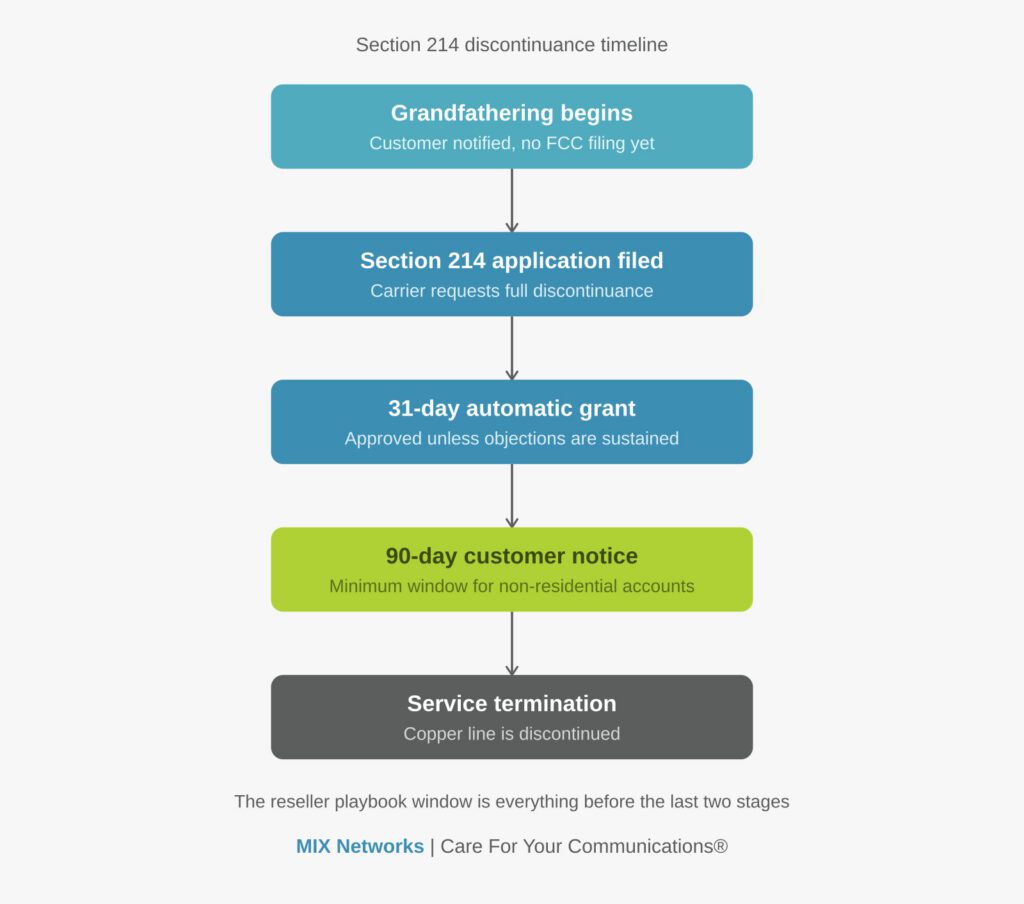
That brake pedal got a lot softer this spring. On March 26, 2026, the FCC adopted the Network and Services Modernization Order, and it rewired how Section 214 discontinuance works for legacy copper. Carriers now hold blanket Section 214(a) authority to grandfather legacy voice, low-speed data, and copper-based VoIP service without filing anything with the FCC first. A formal Section 214 application only becomes necessary when the carrier is ready to fully retire the service, and once that application is filed, it’s now subject to a uniform 31-day automatic grant period, dominant and non-dominant carriers alike. The order also eliminated the separate network-change disclosure filing requirement that used to run alongside it, and it preempts state and local rules that would otherwise slow a federally authorized discontinuance.
The net effect for resellers: the window between “carrier decides to retire a wire center” and “customer’s copper goes dark” has compressed at every stage. Non-residential customers still get a minimum 90-day termination notice once a Section 214 application is granted, but the quiet grandfathering that happens before that notice ever goes out can start well before an account team sees it coming.
Why This Is a Reseller Problem, Not Just a Carrier Problem
Resellers sit closer to the end customer than the carrier ever will, which means the fallout from a Section 214 discontinuance lands on the reseller’s desk first, whether or not the reseller had any advance warning. A customer running fire panels, elevator phones, or alarm circuits on copper doesn’t call the underlying carrier when the line goes quiet. They call whoever sold them the service.
That’s precisely why the discontinuance conversation can’t be reactive. Every account still running voice, fax, or life-safety equipment over copper needs to be inventoried and ranked by risk before a notice arrives, not after. Wire centers already approved for retirement, like the ones covered under AT&T’s California order affecting 360 wire centers and roughly 184,000 residential and 15,000 business lines, are the leading edge of a pattern that the Modernization Order is built to replicate nationally.
Building the Playbook: What to Do Before the Notice Arrives
A reseller’s discontinuance playbook comes down to three moving parts, done in order and done early.
First, inventory every copper-dependent line in the book of business, with particular attention to life-safety circuits that carry code obligations most generic replacement products can’t satisfy on their own. Second, map each account to a replacement path before a Section 214 notice forces the timeline. A dual life-safety certified solution, like a POTS in a Box® platform carrying both FDNY and California OSFM UL 864 certification, closes the compliance gap that a standard VoIP adapter leaves open. Third, build the customer conversation around certainty rather than urgency. Customers who hear about copper retirement for the first time via a 90-day notice tend to make rushed, worse decisions than customers whose reseller raised it six months earlier.
The Bottom Line for the Channel
Section 214 used to be background noise for most resellers, a regulatory process that played out on a timeline nobody in the channel needed to track closely. That’s no longer true. The Network and Services Modernization Order turned discontinuance into a fast, largely carrier-driven process, and the resellers who treat it that way, tracking wire center status, prioritizing life-safety accounts, and positioning certified replacement products ahead of the notice, are the ones who turn a compliance deadline into a renewal conversation instead of a churn event.