California gets the headlines. The copper sunset is already underway across the South, Midwest, Northeast, and Mountain West. Since the FCC’s March 2026 order, a carrier can retire copper with as little as 90 days’ public notice, and a dead POTS line won’t send an error. Here is the state-by-state watch list every telecom agent should have open this quarter.
Why Copper Retirement Moved From Slow to Fast
On March 26, 2026, the FCC adopted the Network and Services Modernization Order (FCC 26-19). It removed the network change disclosure filings, created a 31-day automatic grant window for Section 214 discontinuance applications, and preempted state rules that delay a retirement the FCC has already authorized. The practical result: notice to disconnect can shrink from 6 to 12 months down to as little as 90 days.
Carriers moved fast. AT&T began decommissioning copper in roughly 500 wire centers in June 2026, about 10 percent of its network, and has set a goal to exit copper across most of its 21-state footprint by the end of 2029. Verizon, Frontier, Lumen and Windstream are all filing too.
The damage lands on the lines nobody inventories: fire alarm panels, elevator emergency phones, E911 circuits, and security and access control systems. Those systems follow codes like NFPA 72 and ASME A17.1, and they fail silently. The panel stops reporting. The elevator loses dial tone. Nobody knows until someone needs it.

California Is the Test Case, Not the Whole Story
On June 29, the FCC cleared AT&T to discontinue copper voice service at more than 184,000 California locations, with discontinuance proposed on or after June 1, 2027. The California Public Utilities Commission is fighting back on every front. It is suing the FCC over the March order, AT&T is suing the CPUC over carrier of last resort rules, and on September 23, California’s attorney general asked a federal judge to toss AT&T’s suit.
The outcome matters because it will set the template for how far federal preemption reaches into state carrier-of-last-resort rules. But do not wait on the court. The waves below are already on the calendar.
The State-by-State Copper Retirement Watch List
Florida, Texas, North Carolina, Wisconsin, and Indiana each appear in four separate retirement waves between now and January. South Carolina shows up in three. Here is the full calendar, earliest cutover first.
| Wave | Carrier | States | Earliest cutover | Status |
| 1 | AT&T | AL, LA, MS | Sept. 30, 2026 | Residential date has passed |
| 2 | AT&T | AR, FL, GA, IN, KS, LA, MO, NC, OK, SC, TN, TX, WI | Oct. 16, 2026 | Residential and business |
| 3 | Verizon and Frontier | AZ, DE, NJ, NM, OH, RI, SC, UT, VA | Oct. 23, 2026 | Pulled from automatic grant for fuller FCC review |
| 4 | AT&T | AL, AR, FL, GA, IN, KS, KY, LA, MI, MO, MS, NC, OH, OK, SC, TN, TX, WI | Nov. 15, 2026 | Residential and business |
| 5 | Frontier and Citizens | FL, IN, MN, NC, NE, NV, TX, WI | Nov. 16, 2026 | Residential and business |
| 6 | Verizon and Frontier | CA, CT, DC, IL, MD, MA, MI, NY, PA, WV | Nov. 30, 2026 | About 750,000 locations, filed Sept. 9 |
| 7 | AT&T | FL, GA, IN, KS, LA, MO, NC, OK, TX, WI | Jan. 29, 2027 | Residential and business |
| 8 | AT&T | CA | June 1, 2027 | FCC cleared, state fight ongoing |
| Later | Lumen and Windstream | AZ, CO, ID and other legacy CenturyLink and rural Windstream states | Filings expected 2026 to 2029 | Market by market |
Dates are earliest cutover dates from carrier filings as compiled in published trackers and calendars (The Land Line Group, BCN) as of Oct. 15, 2026. Verify every docket before you quote a date to a customer. The Verizon and Frontier nine-state application is the one to watch most closely, because the FCC took it off the automatic track and the outcome could move the date.
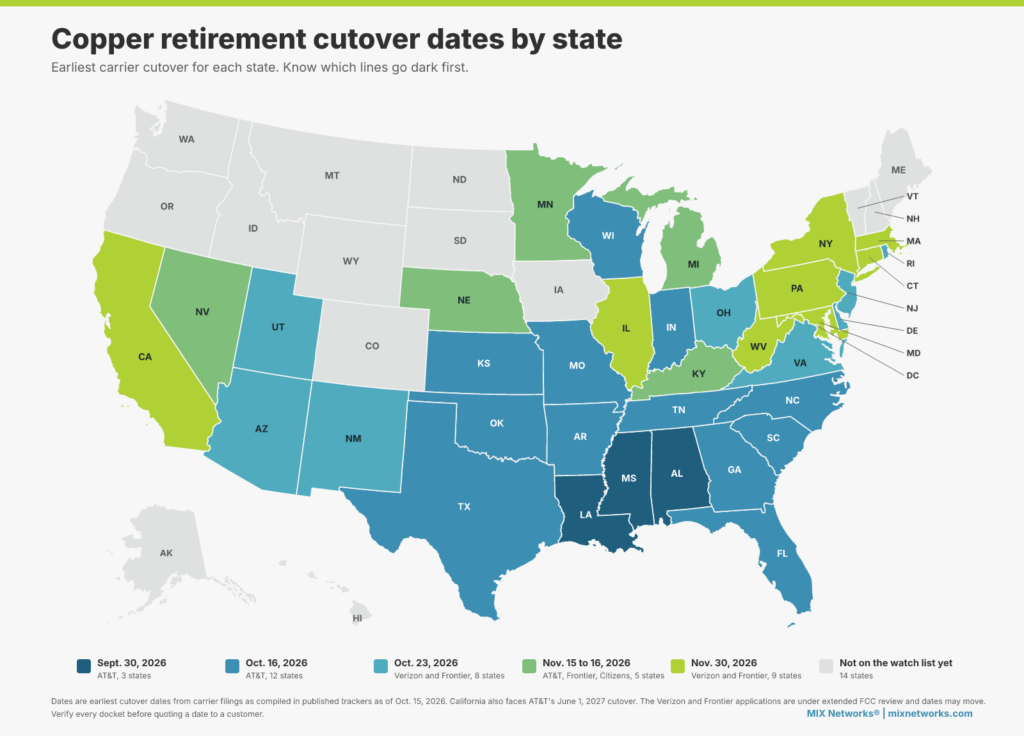
Three patterns stand out. AT&T owns the earliest and heaviest waves across the South and Midwest. Verizon and Frontier are now filing at scale in the Northeast, the Mountain West and the Mid-Atlantic. The Frontier and Citizens wave on Nov. 16 lands one day after AT&T’s Nov. 15 wave in five of the same states: Florida, Indiana, North Carolina, Texas, and Wisconsin. Customers in Minnesota, Nebraska, and Nevada face the Frontier date on its own.
What Agents Should Do Before the Next Cutover
Sort your book by state. Match every customer address to the waves above and work the earliest dates first. Waves 2 through 5 are urgent and cover the South, the Midwest, and the Mountain West.
Hunt the hidden lines. A carrier cannot tell from an account name whether a line ends at a desk phone, an elevator, or a fire panel. Pull every analog and POTS charge from the invoices, then ask what sits on the other end of each one.
Run life safety as its own track. Fire panels, elevator phones, and alarm dialers need a POTS replacement built for life safety, not a generic VoIP adapter. Confirm battery backup, supervision, and approval with the monitoring company and the authority having jurisdiction.
Respect the 90-day clock. Site surveys, installs, and inspections take time. Quote the replacement before the notice lands, because rushed installs mean premium pricing and compliance risk. Our copper retirement and POTS replacement timeline walks through the planning steps.
Copper Retirement FAQ
Which states are losing copper phone service first?
Published calendars put AT&T’s earliest business cutovers in Arkansas, Florida, Georgia, Indiana, Kansas, Louisiana, Missouri, North Carolina, Oklahoma, South Carolina, Tennessee, Texas and Wisconsin, starting Oct. 16, 2026. Verizon and Frontier follow with nine more states on Oct. 23 if the FCC clears the application.
How much notice does a carrier give before retiring copper?
Under the FCC’s streamlined rules, a copper retirement can take effect on as little as 90 days of public notice. Discontinuance applications now face a 31-day automatic grant window.
What happens to fire alarm and elevator phone lines when copper is retired?
They stop working without an alert. Fire panels and elevator phones need a POTS replacement designed for life safety, confirmed with the authority having jurisdiction.
Get Ahead of the Notice
Don’t let a 90-day clock choose your customers’ replacement for you. Talk to MIX Networks about POTS replacement for life-safety lines in your state.